VARGATES Medical
VARGATES Medical: a clinical case is played as a scene
The VARGATES Medical clinical scenario player has been rebuilt: the student acts on objects in the frame, the case keeps its own time and a monitor, a decision takes one press, and the run ends on a report and a tree of events. The first case to work this way is CASE-015 in paediatric cardiology.
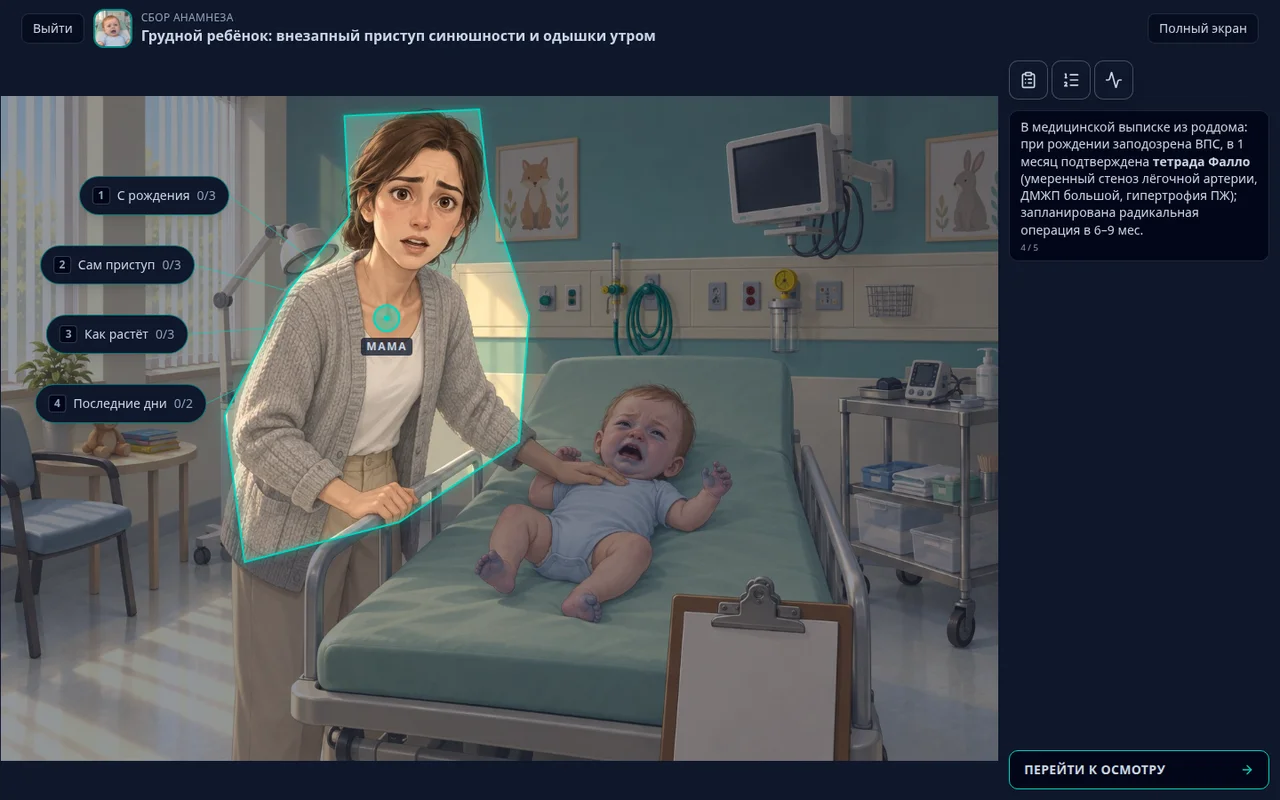
VARGATES Medical is a medical education platform at medical.vargates.com, developed by DreamLight Labs. Between 6 and 10 October 2026 the team rebuilt its clinical scenario player: a clinical case is now played as a scene rather than as a list of actions under the text. The first case to work this way is CASE-015, an infant with a sudden morning attack of cyanosis and shortness of breath, from the Paediatric Cardiology programme. It is open without signing up: the scenario page.
A case starts with a card
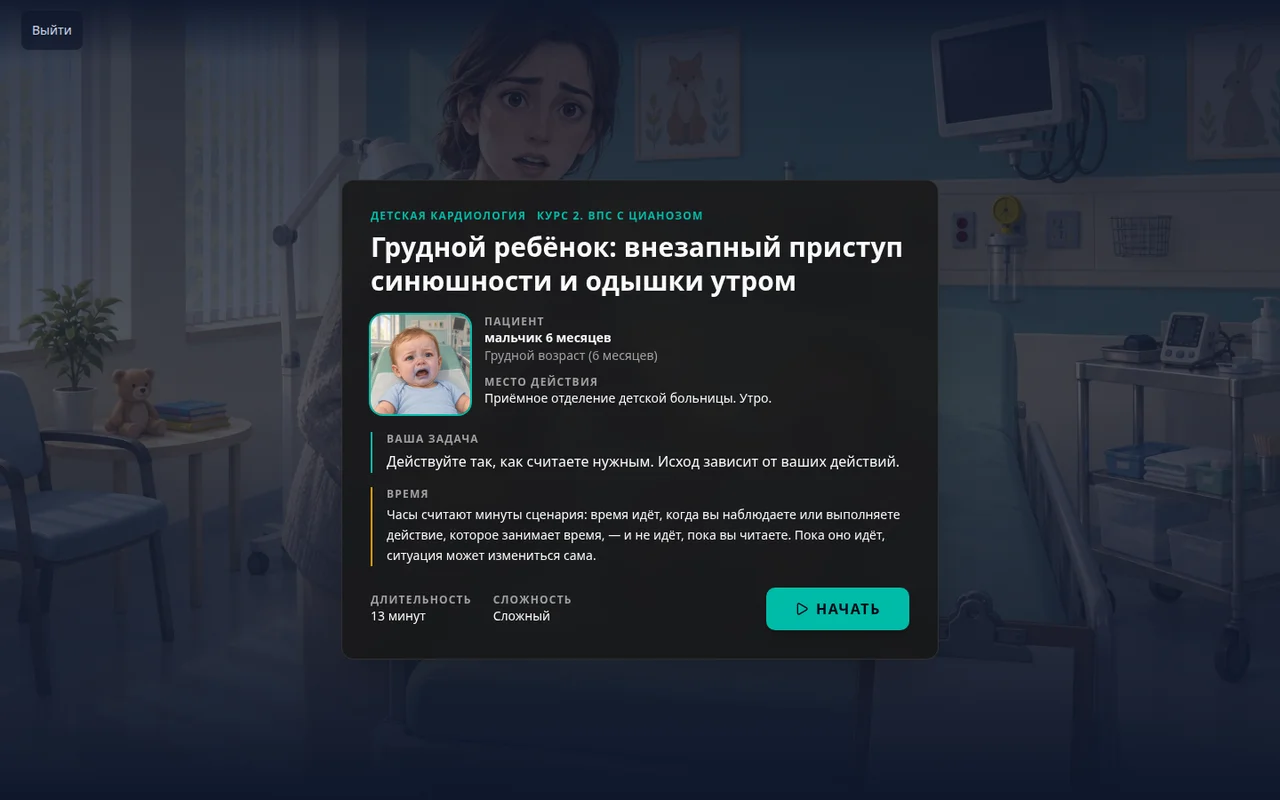
Before the run the student sees the case card: the programme and course, the patient, the setting, the task, the length and the difficulty. While the card is on screen the run has not started and no time passes.
Actions sit on objects in the frame
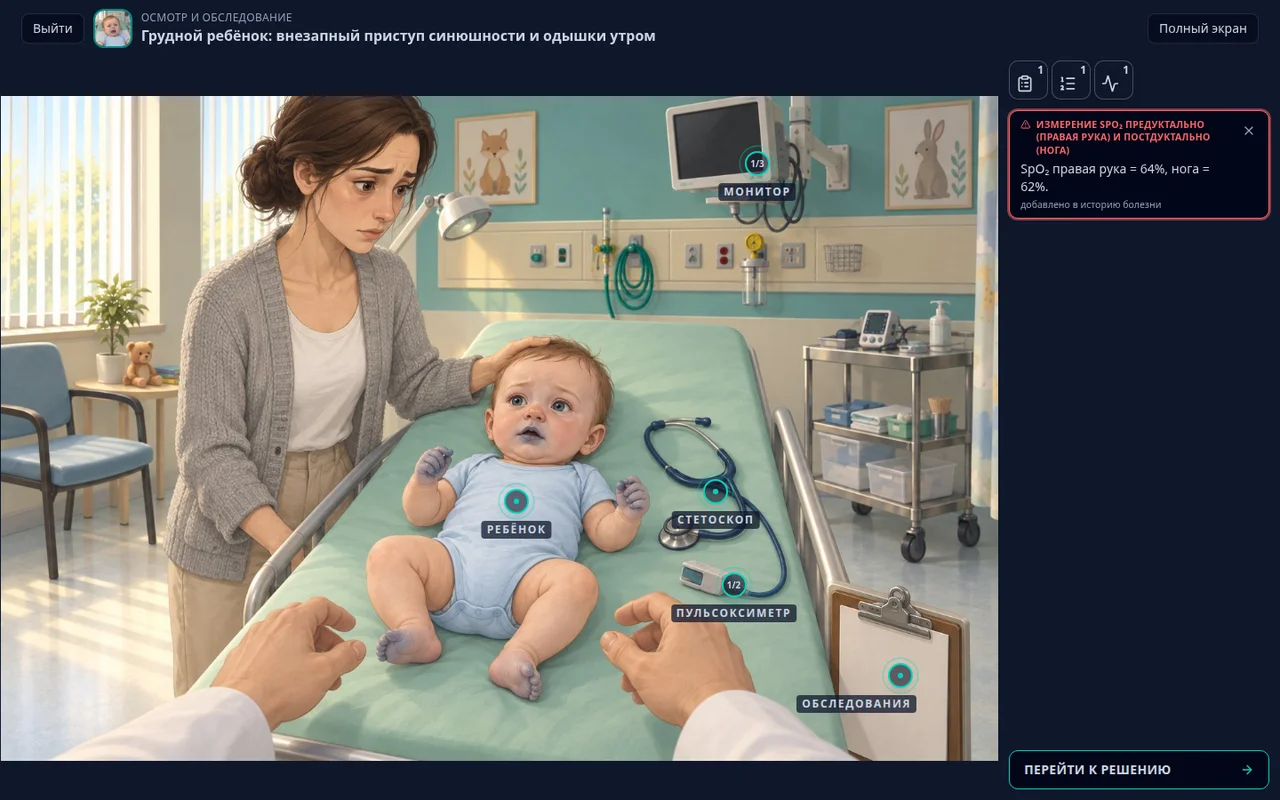
The run fills the whole window, with no site header. The student presses what they see in the frame: the mother, to take the history; the stethoscope or the pulse oximeter, to examine the child; the monitor, to open the monitor window.
A finding appears at once and goes into the case history. The grading of decisions is not shown during the run — the debrief waits for the end.
The case history, the visit log and the monitor are three windows. The student opens them when needed and, on a wide screen, arranges them as they like.
Every action in history-taking, examination and the emergency steps has its own picture — 37 in all.
The case keeps its own time
The clock counts scenario minutes, not seconds at the screen: time passes when the student observes or takes an action that takes time, and stands still while they read. In CASE-015 the tactics step counts down: watching for eight minutes without choosing a tactic ends the case in the outcome its author described for that.
The monitor draws pulse, saturation and breathing curves at the rates written in the case. A reading becomes an alarm only where the case author set one: the player has no norms of its own.
A decision is a moment of its own
When the case asks for a diagnosis or a tactic, the frame freezes, the windows are put away and the options stand on free ground in the picture, never on a person; on a phone they are a list under the picture. A choice takes one press and cannot be taken back — as at an appointment.
The ending: a report and a tree of events
A run ends on the picture of its outcome with three buttons: Report, Tree of events and Exit. The report shows the outcome, the data collected, the score and what decided the outcome. The tree of events shows the path taken through the scenes; branches the student has not opened stay locked and reveal nothing about themselves. The case can be replayed from any point already opened. CASE-015 has six outcomes in all.
The whole case is one document
The whole case is now stored as one document in CaseFlow, the studio's format for clinical scenarios, and the player reads nothing else. Findings, the full decision texts, debriefs and outcomes were checked against the original case character for character. The text of one outcome — an incomplete algorithm — did not exist in the original case: the platform added it, the document marks it so, and it awaits clinical review.