VARGATES Medical
A finished course no longer has to be rebuilt for VARGATES Medical
For a training centre or department with its own materials: videos, 3D models and standard-format courses become platform lessons, and completing them counts toward progress and the certificate.
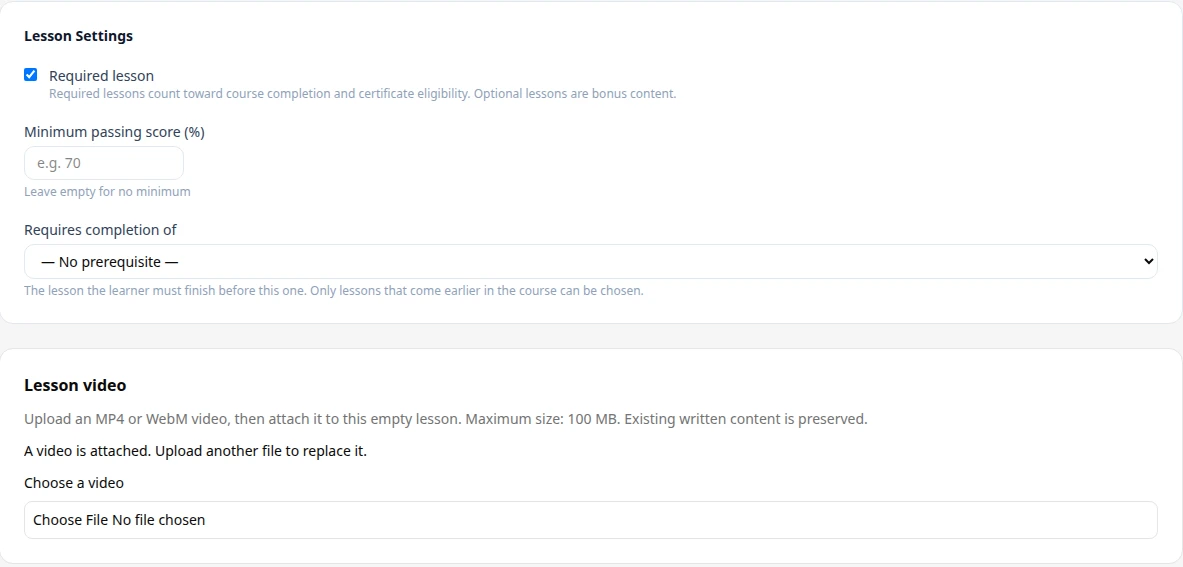
The VARGATES Medical lesson editor now has three new ways to fill a lesson. An author can upload their own MP4 or WebM video of up to 100 MB, a 3D model in GLB format, or a learning-package archive in one of four formats: SCORM 1.2, SCORM 2004, xAPI or cmi5. Since 25 October all three work on the live platform.
An uploaded course follows the platform's rules
A package keeps its state: if a learner closes the lesson halfway, the next launch hands the package its saved bookmark and it continues from there. Finishing a package counts toward course progress and the certificate through the same mechanisms as every other lesson; uploaded courses have no separate bookkeeping. If a package fails to launch, the learner sees an error message and a Retry button.
The package lives apart from the learner's account
A learning package runs on a separate address rather than inside the learner's account: the account page, its storage and the learner's sign-in key are out of the package's reach. Every request the package makes rechecks that the learner belongs to the organisation and has access to this material.
A file opens only for those who can open the lesson
Videos and 3D models are kept in private storage. A learner receives a short-lived link to the file only after the ordinary lesson access check. The lesson can be completed once the video has actually decoded in the browser and the model has loaded and rendered. The model rotates with the mouse or arrow keys and zooms with the wheel, a pinch or Page Up and Page Down.

Only a self-contained GLB with its textures inside the file is accepted. Models compressed with Draco, Basis or Meshopt decoders are not supported yet.
We had to withdraw the first package release
Packages first reached the live platform on 24 October, and the check there showed they would not start: behind the secure proxy the server handed packages http addresses, and an account opened over https rejects them. We rolled the release back. Addresses now come from a setting that holds the platform's public https address, and with a wrong setting the server refuses at once, before any access is issued. The corrected version shipped on 25 October, and all four formats passed the check on the live platform at desktop and mobile window widths.